Chat with Agina Chat with us on WhatsApp
Features
Server Type / Form Factor
  • Type: Enterprise Rack Server


  • Form Factor: 1U Rack


  • Socket: Single-socket (1 x Intel Xeon 6 P-core processor)
  • Type: Enterprise Rack Server


  • Form Factor: 1U Rack


  • Socket: Single-socket (1 x Intel Xeon 6 Processor)
Processor (CPU)
  • Processor Family: Intel Xeon 6 (Rich I/O P-core series)


  • Max Sockets: 1


  • Max Cores per Socket: Up to 144 cores


  • Max TDP: Up to 350 W (varies by CPU model)


  • Memory Channels: 8 channels per processor
  • Processor Family: Intel Xeon 6 (E-core or P-core series)


  • Max Sockets: 1


  • Max Cores: Up to 144 E-cores or 86 P-cores


  • Max TDP: Up to 330W (Sierra Forest SRF)


  • PCIe Lanes: 88 PCIe Gen5 lanes per CPU
Memory (RAM)
  • Memory Type: HPE DDR5 Smart Memory (RDIMM)


  • DIMM Slots: 16 DIMM slots


  • Maximum Capacity: Up to 4 TB (with 256 GB modules)


  • Speed: Up to 6400 MT/s memory (1DPC)


  • Protection: ECC and advanced RAS features
  • Memory Type: DDR5 RDIMM (registered ECC only)


  • DIMM Slots: 16 DDR5 DIMM slots


  • Maximum Capacity: Up to 4 TB


  • Speed: Up to 6400 MT/s


  • Protection: ECC with advanced RAS features
Storage
  • Drive Bays (Front): Up to 20 EDSFF E3.S NVMe drive bays


  • SFF Options: 2 SFF x4 Tri-Mode 24G U.3 BC drive cages


  • Backplane Options: 8 SFF x1 or x4 Tri-Mode 24G U.3 BC backplanes


  • Boot Options: Optional NS204i-u Hot-Plug Boot Device (front or rear)


  • Storage Controllers: HPE OCP-type RAID (OROC) or PCIe-based controllers
  • Front Drive Bay Options: Up to 8 x E3.S NVMe SSD


  • Configuration Option: Up to 8 x 2.5-inch SAS/SATA/Nearline SAS/NVMe


  • Boot Optimization: NVMe BOSS (Boot Optimized Server Storage)


  • RAID Support: PERC H965i/H365i controllers (RAID 0, 1, 5, 6, 10, 50, 60)
Expansion / Connectivity
  • PCIe Slots: Multiple PCIe 5.0 x16-style slots (primary and secondary riser configuration)


  • OCP Slots: Front or rear OCP 3.0 networking slots (1 Gb / 10 Gb / higher options)


  • GPU Support: Up to four single-wide GPUs or two double-wide GPUs (configuration dependent)


  • Ports / I-O: USB 3.2 Gen1 front ports


  • Video Options: Optional DisplayPort / VGA via DC-SCM


  • Management Port: Dedicated iLO service port
  • PCIe Slots: Up to 2 x16 Gen5 PCIe slots (riser configuration)


  • Networking: OCP 3.0 (1/10/25 GbE options)


  • GPU Support: GPU-enabled configurations available


  • I/O Options: Rear I/O (hot aisle) or Front I/O (cold aisle)
Redundancy & Reliability
  • Power: Modular Common Redundant Power Supply (M-CRPS) design; redundant hot-plug power supplies optional


  • Cooling: Integrated system fan array (7 fans) with hot-swap capability


  • Availability Features: DC-MHS-based hot-swap components, quick-removal access panel, and enterprise-grade serviceability
  • Power: Redundant hot-plug PSUs (800W Platinum, 1500W Titanium)


  • Cooling: Redundant hot-swap fans; advanced cooling options


  • Reliability: Hot-swap components, tool-less serviceability
Operating System Support
  • Microsoft Windows Server


  • Red Hat Enterprise Linux (RHEL)


  • SUSE Linux Enterprise Server (SLES)


  • VMware ESXi


  • Canonical Ubuntu


  • Oracle Linux
  • Microsoft Windows Server with Hyper-V


  • Red Hat Enterprise Linux (RHEL)


  • Canonical Ubuntu Server LTS


  • VMware ESXi


  • SUSE Linux Enterprise Server (SLES)
Security Features
  • HPE iLO 7 security and secure boot


  • Intel-based hardware security (P-core protections and Rich I-O options)


  • UEFI-managed firmware integrity and TPM-class key management


  • Data-at-rest protection via HPE-approved self-encrypting and encrypted-drive options
  • Dell SafeBIOS Secure Core


  • System Lockdown and Cryptographic Erase


  • Firmware Update Verification and TPM 2.0


  • Secure Boot and Multi-Factor Authentication
Management & Monitoring
  • HPE iLO 7: Remote console, firmware updates, and configuration


  • Redfish API: Support for orchestration and integration


  • HPE Tools: Cloud operating experience and modular hardware-management capabilities
  • iDRAC10 Enterprise: Embedded remote management


  • Dell OpenManage Enterprise: AI-driven management


  • APIs: Redfish APIs for automation and orchestration
Warranty & Support
  • Standard Warranty: 3 Years Parts, 3 Years Labor, 3 Years Onsite (region- and contract-dependent)


  • Optional Support: HPE Pointnext services, Foundation Care, Proactive Care, and custom SLAs for edge, SMB, and ROBO deployments
  • Standard Warranty: 3 Years ProSupport (parts, labor, onsite)


  • Optional Support: ProSupport Plus, ProSupport Enterprise, extended terms

Key Features Comparison

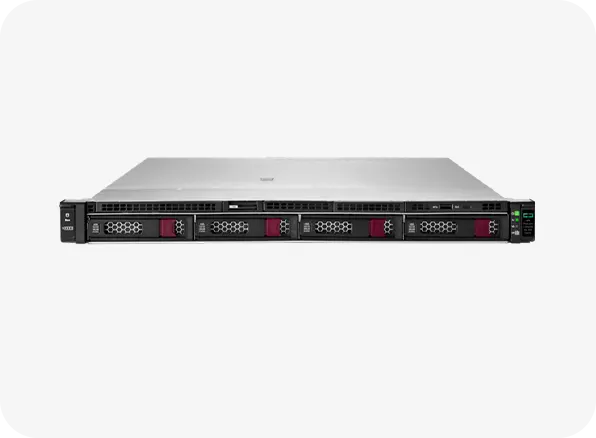
HPE ProLiant Compute DL320 Gen12

High-Performance 1U 1-Socket Compute
The HPE ProLiant Compute DL320 Gen12 is a 1U, single-socket rack server powered by Intel Xeon 6 Processors, supporting up to 144 cores per socket, making it ideal for cloud-native, IaaS, virtualized, and containerized workloads.
High-Density Memory & Efficient Design
It supports up to 4 TB of DDR5 6400 MT/s memory in a compact 1U chassis, enabling dense, memory-intensive applications while consuming considerably less energy than 2P systems for edge-optimized deployments.
Flexible High-Speed Storage Options
The server supports up to 20 EDSFF E3.S NVMe drive bays and multiple SFF / LFF configurations, including front-OCP-based boot-drive options, offering scalable, high-speed storage for data-intensive and edge-compute use cases.
Advanced PCIe 5.0 & GPU Support
Built on PCIe Gen5, the DL320 Gen12 provides multiple PCIe x16-style slots plus OCP 3.0 front- or rear-facing I/O; it supports up to four single-wide GPUs or two double-wide GPUs for AI, analytics, and edge-accelerated applications.
Modular HPE Infrastructure & DC-MHS Design
Designed with Data Center-Modular Hardware System (DC-MHS) and Modular-Common Redundant Power Supply (M-CRPS) architecture, the DL320 Gen12 delivers right-sized, serviceable compute optimized for edge and cloud-native environments.
Built-In Security & HPE iLO 7 Management
It includes HPE iLO 7 on the DC-SCM module, providing embedded remote management, secure boot, firmware updates, and Redfish-based APIs, together with HPE’s security-by-design approach for data protection at boot, in-use, and at rest.
Energy-Efficient Single-Socket Intel Compute
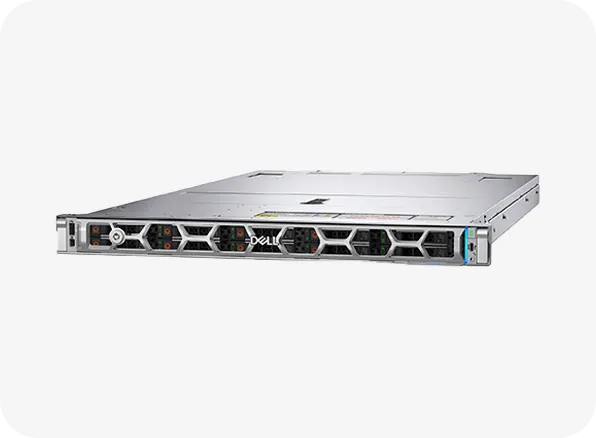
The Dell PowerEdge R470 is a 1U rack server powered by one Intel Xeon 6 Processor (E-core up to 144 cores or P-core up to 86 cores), designed for maximum energy efficiency and performance-per-watt in cloud-scale microservices, data services, virtualization, and scale-out databases.
High-Density DDR5 Memory Capacity
Supports up to 4 TB of DDR5 RDIMM memory across 16 DIMM slots with speeds up to 6400 MT/s, providing substantial headroom for memory-intensive applications while maintaining ENERGY STAR compliance.
Flexible NVMe & SAS/SATA Storage
Offers front drive configurations including up to 8 x E3.S NVMe SSDs or 8 x 2.5-inch SAS/SATA/NVMe drives, with NVMe BOSS boot optimization for fast OS deployment and scalable all-flash storage in dense 1U form factor.
PCIe Gen5 Expansion & GPU Support
Built on PCIe Gen5, it provides up to 2 x16 PCIe slots plus OCP 3.0 networking, supporting GPUs and accelerators for enhanced computational power while optimizing energy consumption in high-density racks.
Enterprise Security & iDRAC10 Management
Features Dell SafeBIOS Secure Core, system lockdown, cryptographic erase, and firmware verification, paired with iDRAC10 Enterprise, OpenManage Enterprise, and Redfish APIs for automated management.
1U Density with Rear/Front I/O Flexibility
Available in rear I/O (hot aisle) and front I/O (cold aisle) configurations with redundant hot-swap PSUs (800W Platinum, 1500W Titanium) and advanced cooling, maximizing rack density while reducing operational costs.

HPE ProLiant Compute DL320 Gen12 vs PowerEdge R470 Rack Server : Which should I choose?

Choosing the right server is a critical decision for any business, and comparing HPE ProLiant Compute DL320 Gen12 and PowerEdge R470 Rack Server gives you clear insights into which solution aligns best with your IT requirements. These servers are built for high performance, but they may differ in areas such as processor capacity, memory, storage, and scalability, making a side-by-side comparison easy.

This direct comparison helps you quickly identify the strengths and limitations of each server, which helps you determine which model best supports your workloads, applications, and long-term IT goals. By evaluating them together, you can make a smarter investment that ensures reliability and efficiency for your business.

Looking for more Servers Brand wise?

Discover the full range of

Still unsure which Servers is right for you?

Contact Infome for expert guidance.

Infome Expert Consultation