
10 Warehouse Challenges UAE Businesses Face and How to Solve Them
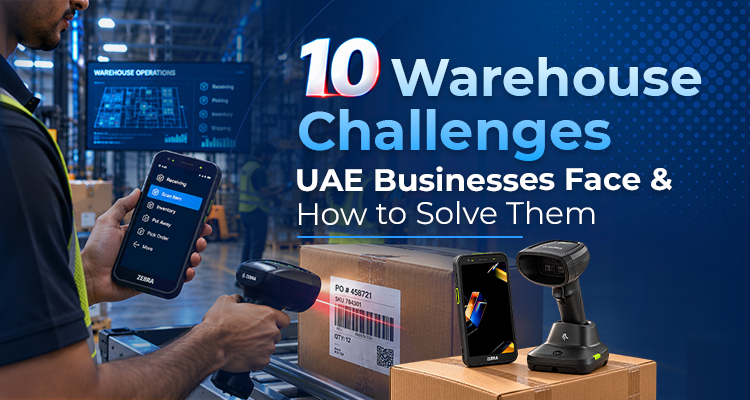
10 Warehouse Challenges UAE Businesses Face and How to Solve Them
The warehouse handles thousands of orders daily, which increases the chance of warehouse mistakes that can cost time and money. This raises the relevance of adopting warehouse solutions in UAE to make your daily operations smoother and more accurate. Warehouse solutions are technologies and tools that can manage inventory, track products, and handle the goods movement throughout warehouse operations. They are suitable for managing various warehouse challenges such as inaccurate stock records, misplaced products, slow picking, manual data entry, and shipping errors.
Let us explore the 10 challenges that warehouses in UAE face and how to handle them with the right technology.
Managing a warehouse requires the joint effort of staff and solutions. However, mistakes in warehouse operations result in inaccurate stock records and slow order processing. Here are the 10 common warehouse challenges and the technologies that can help solve them.
1. Manual Inventory Tracking Causing Errors
Employees depend on handwritten records, manual data entry, and spreadsheets, which raises the chance of inventory errors. They might miss recording the inventory details, which leads to incorrect stock placement, overstocking, or stock shortages.
Solution: Use mobile computers and barcode scanners that help warehouse staff to update inventory information directly. Workers can scan the product's barcode and update the warehouse management system instead of writing down product details.
2. Slow picking and packing
Staff have to spend extra time to locate and verify products, which creates unnecessary delays in picking and packing products. This leads to picking errors, and employees may need to spend extra time correcting shipments.
Solution: Mobile computers can help staff to manage daily inventory and order information while they are moving. These handheld systems can receive picking instructions, scan product barcodes, verify item quantities, and update the order status immediately. This lets staff complete picking and packing more efficiently.
3. Inventory misplacement makes product tracking difficult
Without a proper tracking system, employees cannot locate stock quickly. This increases order processing time and customer delivery time, affecting labour productivity and inventory accuracy.
Solution: Each product is assigned a unique barcode, and employees can scan items during receiving, transfer, and picking and record their exact location. RFID technology uses radio frequency signals that help to identify tagged products and easily track multiple items as they move through the warehouse.
4. Shipment errors
Staff may select the wrong items and enter the wrong quantity during shipments. This results in product returns, shipment replacements, additional delivery costs, and delays in customer service.
Solution: Barcode scanners help warehouse employees scan and confirm that the picked product matches the order and verify the quantity before packing. Using thermal printers to print barcodes and receipts can make the shipment process accurate.
5. Slow goods receiving
Receiving goods involves checking incoming products, quantities, purchase orders, and shipment details. This causes delays in receiving items that lead to congestion at loading areas, slow down stock availability, and affect warehouse activities.
Solution: Using mobile computers, warehouse staff can receive information directly at the loading area. Barcode scanners allow employees to quickly verify incoming items and update the receiving products.
6. Damaged or Unreadable Labels Affect Warehouse Operations
Product labels contain various details such as product code, serial number, and shipping details. Damaged, faded, or poorly printed labels are difficult to scan, which makes product identification a challenge for staff.
Solution: An efficient thermal label printer can print durable labels for product identification and inventory tracking, which can make the shipment process fast and accurate.
7. Difficulty Tracking High-Volume Inventory Movement
Tracking each item individually takes a long time when goods move between receiving, storage, production, and dispatch areas. Without an efficient tracking system, managers will have limited visibility into inventory movement.
Solution: RFID technology uses radio frequency signals to identify tagged products and can easily identify multiple tagged items without scanning them individually. This offers faster and more automated inventory movement tracking.
8. Time-consuming manual stock counting
Manually counting a large number of stock items consumes more time, which slows down warehouse operations. Taking more time to manage inventory volume makes it difficult to complete stock counts quickly and accurately.
Solution: Using a handheld barcode scanner or mobile computers allows you to digitally record products during stock counting. These technologies reduce manual counting effort and make inventory audits more organized.
9. Unnecessary Paper and Printing Costs
Manual paper-based work for warehouse operations requires creating large quantities of forms, inventory sheets, and receiving documents. The cost of paper, printing, storage, and document management can consume more money. Moreover, paper-based records can also become damaged, misplaced, or difficult to update.
Solution: Adopting a mobile computer can replace many paper-based processes. This allows employees to record product details and stock movements and update inventory operations.
10. Excessive labour cost for manual warehouse processes
Traditional warehouse operations require more staff to manage daily tasks such as recording inventory, checking product details, counting stock, and preparing labels manually. This increases labour costs without improving operational efficiency.
Solution: Mobile computers allow employees to complete warehouse tasks digitally, and barcode scanners speed up product identification and reduce repetitive manual entry. RFID can identify multiple tagged items, which reduces the time for individual scanning.
The Right Warehouse Technology for Your Warehouse Requirements
Modern warehouse operations need technologies that help them manage various warehouse needs. Here are various technologies that help to manage different warehouse operations.
- Warehouse Requirement: Product identification | Recommended Technology: Barcode scanners
- Warehouse Requirement: Real-time inventory updates | Recommended Technology: Mobile computers
- Warehouse Requirement: Automated tracking | Recommended Technology: RFID systems
- Warehouse Requirement: Product labelling | Recommended Technology: Industrial label printers
- Warehouse Requirement: Shelf and location identification | Recommended Technology: Barcode labels and printers
- Warehouse Requirement: Stock counting | Recommended Technology: Barcode and RFID devices
- Warehouse Requirement: Receiving and dispatch | Recommended Technology: Mobile computers and barcode scanners
How to Choose the Right Warehouse Technology for Your Business in UAE?
Warehouse operations in UAE differ in various aspects, and each warehouse requires technologies that properly align their work. Let us discuss the factors that you have to consider before buying a warehouse solution for your business.
- Warehouse Size: Handheld barcode scanners and mobile computers are suitable for smaller warehouses that deal with a small to moderate number of products daily. However, if you are handling a large warehouse with a large number of products, use RFID for tracking. Use an industrial label printer for label printing and a rugged barcode scanner and mobile computer for scanning and inventory management.
- Product Volume: Businesses that handle large volumes of inventory need automated identification and tracking technologies.
- Industry Requirements: Retail, manufacturing, logistics, healthcare, automotive, and distribution warehouses in UAE may have different tracking and labeling requirements. Identify your industry type and daily requirements, like label printing, product tracking, and inventory updating, and choose systems that match your industrial needs.
- Environmental Conditions: Warehouses operating in outdoor yards, dusty environments, or industrial facilities need rugged mobile computers and durable thermal printers. Ordinary warehouse conditions can rely on standard printers and barcode scanners that can manage operations efficiently.
Why Businesses in UAE Need Warehouse Solutions?
- Improve Inventory Accuracy: Barcode scanners and mobile computers allow staff to accurately capture product information digitally. This inventory information will help warehouse managers know the exact location of stock and its availability without searching for paper documents. This can reduce manual counting errors and maintain stock availability.
- Enable Faster Order Fulfilment: The mobile computers can manage order and inventory information. Barcode scanners help verify products quickly, while thermal printers handle label printing. These technologies help managers improve order processing speed and make the workflow easier.
- Offers accurate stock visibility: Warehouse solutions provide accurate inventory information on stock movement, storage space, and daily operations. This allows staff to update accurate stock levels, product location, and inventory status.
- Improve Warehouse Labour Efficiency: This device can handle manual data entry and daily tasks, which can save employees time and effort. Barcode scanners speed up product identification, and RFID can make tracking activities smooth in the warehouse.
- Ensure Accurate Product Identification: Barcode scanners ensure quick and consistent product identification, and thermal label printers print clear labels that can be scanned for accurate identification.
Delays and mistakes in warehouse operations can affect the industry's growth. Therefore, adopting the right technology can speed up daily tasks and make inventory management easier. Infome Technologies is here to provide you with solutions like barcode scanners, thermal printers, mobile computers, and RFID systems designed to make warehouse operations more efficient. We support our customers with the best guidance and after-sales support. Get in touch with us and get the right technology that can transform warehouse workloads.
Frequently Asked Questions and Answers
-
How can barcode scanners reduce inventory errors?
Barcode scanners allow employees to scan product details instead of entering them manually. Staff can scan items during receiving, stock transfers, picking, packing, and dispatch. This reduces the chance of missed entries and incorrect quantities. -
What is the difference between barcode scanners and RFID warehouse management systems?
Barcode scanners scan the printed barcodes to identify products. RFID management systems use radio frequency signals to identify tagged products. This is useful for high-volume inventory movement and automated tracking. -
Can barcode scanners scan damaged or unreadable barcodes?
Yes. High-quality and rugged barcode scanners can read damaged or unreadable barcodes. You can also use thermal barcode printers to create labels and barcodes that resist fading and damage. -
How do warehouse management solutions improve stock visibility?
Warehouse management solutions record product movements and update the inventory details digitally. They can help warehouse managers monitor stock availability, product locations, and inventory status without depending on paper documents. -
Can warehouse technology replace manual stock counting?
Warehouse technology can reduce the need for manual stock counting processes. Handheld barcode scanners and mobile computers allow employees to record products digitally during stock counts.
About the Author

The Managing Director and Co-Founder of Infome. With his 19 years of experience in IT solutions and network and security systems, Shan also shares information that focuses on IT infrastructure and antitheft systems.

Top 5 Barcode Scanners for Small Shops in UAE
2026 has already started, and are you still running your shops and retail stores without a barcode scanner?
Read Article
Best Zebra Products in UAE That You Can buy in 2024
Zebra is an industrial giant offering user-friendly and innovative technical solutions for various applications in many countries. From 1969, Zebra has been serving lakhs of customers with the most modern technology that helps them achieve a great growth in their businesses.
Read Article
Need the Right Solution for Your Business?
Our experts will guide you to choose the best Barcode Scanners that fits your needs and budget.

Heidi CP51L vs Professional Card Printers: Choose the Best ID Card Printer for Your Business in UAE
Businesses that issue employee, student, visitor, or access-control cards need more than good-looking prints. Card durability, lamination, security, encoding, printing speed, and long-term usability can all affect the right printer choice. The Heidi CP51L ID card printer combines card printing and integrated lamination, but how does it compare with other professional card printers?
Read Article

Dell Storages in UAE: Explore the Best Storage Solutions for Your Business
Dell storage is a hardware solution developed by Dell Technologies that helps you store, manage, and protect small to large organizational data.The Dell storage family includes PowerVault for small and medium-sized businesses and PowerStore for all-flash block and file storage. For highly demanding and critical workloads, PowerMax is a better option, and you can manage AI and data-intensive applications with Dell PowerScale storage. Dell PowerFlex is for shared block storage networks, Dell ObjectScale can handle advanced AI-related tasks, and PowerProtect is for data backup and recovery
Read Article

Honeywell to Brady: A New Chapter for Productivity Solutions in UAE
As part of a recent business transition, Brady Corporation has completed the acquisition of Honeywell’s Productivity Solutions and Services (PSS) business. Following the acquisition, the Honeywell PSS business will now operate as Brady Intelligent Productivity Solutions (IPS). Brady Corporation completed its acquisition of Honeywell's Productivity Solutions and Services (PSS) business on August 3, 2026, after initially announcing the agreement on April 20, 2026.
Read Article